A core video
The main deep core work for the day.

A 4-phase core restoration program
A step-by-step, Pilates-inspired diastasis program for women who've already done the physio, the Pilates and the planks, but still feel the gap. So that you can finally get back to all the workouts you love!
Doors open soon
// Does this sound familiar?
You've been so consistent. Pilates classes, home workouts, planks held until your arms shake (and probably an ab routine or two you're now a bit suspicious of).
Then you lie back, lift your head, press your fingers just above your belly button, and the gap is still there. Some days it feels soft and deep, like your fingers sink right in. Other days a ridge pops up down your middle the second you curl up or lean back.
So you modify the Hundreds, skip the roll-up, and wonder what you're doing wrong that everyone else seems to be doing so right.
Maybe someone told you the gap would close on its own (or even that it would never close). Maybe you've done months of physio, or two or three online programs, and your gap has barely budged. Some days it even feels wider.
What's usually missing is someone showing you how to get your whole core sharing the load, so the thin strip of tissue down your middle can finally get some support.
That's exactly what I teach inside The Deep Core Method.
// My story

I'm Emma Bromley, a BASI-certified Pilates instructor and Corrective Exercise Specialist, and I've been teaching for over 15 years.
Almost a decade ago, I still had a 5cm separation two years after I gave birth. I could fit my whole fist in the gap! Everything I did, my stomach domed down the middle. And I was supposed to be the expert!
I sought out some highly experienced Pilates mentors who told me "you just need to do more ab exercises". Except the more I did that, the more my gap seemed to be getting WIDER!
And it wasn't only about how it looked. Lifting my daughter into her car seat made my whole middle feel unstable, it made my back ache, and most workouts left me feeling worse than when I started.
My doctor looked at it and said, "The only way to fix that is surgery. Some women just don't bounce back." I refused to believe that could be true.
The turning point came during an advanced training, when I learned how the deep core, the breath, the ribs and the pelvic floor work together to manage pressure, and how much the way you load the tissue matters.
So I changed how I practiced and taught, from the breath out.
It took me a lot of trial and error to work out what actually made a difference. In the end, my gap was back in the normal range: 1cm at my belly button, and nothing above or below it. Gone without a trace! The Deep Core Method is everything I figured out along the way, in the order that works, so you're not left guessing like I was.
Today I do full planks, heavy deadlifts and hard core work without doming, and I can now carry my 11-year-old daughter into her own bed when she falls asleep in mine, without pulling my back out.
Since then, I've taught what I learned to so many women with diastasis, and you'll hear from some of them below. The Deep Core Method takes that work even deeper, for every woman with a gap.
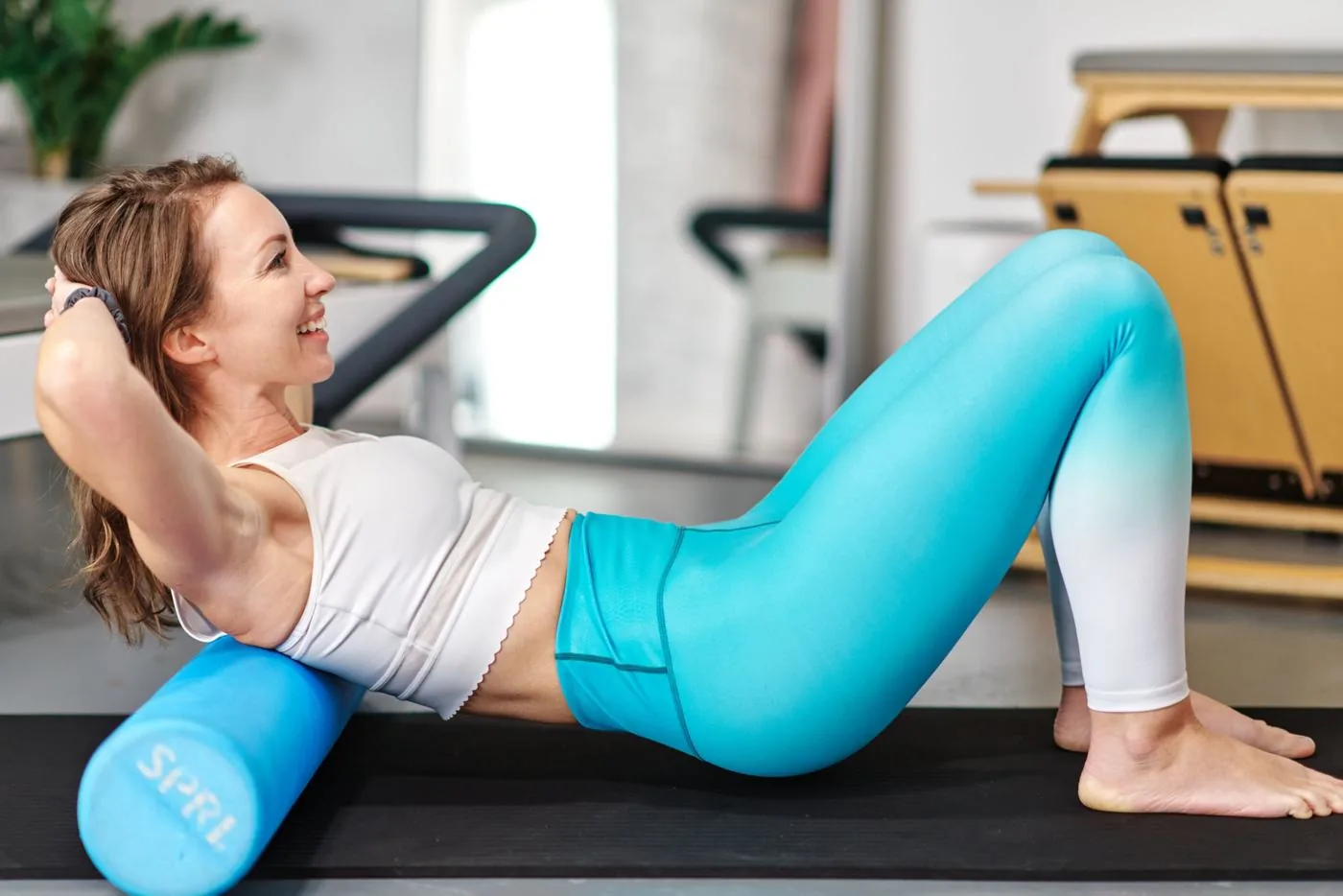
I figured it out,
so you don't have to.
// The anatomy
Your two six-pack muscles are joined by a strip of connective tissue called the linea alba. In pregnancy it stretches and thins to make room for your baby. For many women it gradually recovers. For others the gap stays wider, softer or deeper, sometimes for decades, or until reducing the gap is actively prioritized.
Depth and tension tell us even more than width. A gap your fingers sink into, or a firm dome that pops up when you lift your head, tells you the system isn't managing pressure well yet. A narrower gap with firm, springy tension underneath is what we're working toward.
The transverse abdominis. When it switches on, it pulls the midline taut and reduces sinking and bulging. My students, including Pilates instructors and personal trainers, often tell me nobody had shown them how to access it.
Flared ribs and belly breathing keep pressure pushing forward onto the midline. Learning to breathe into your back and sides, and to bring your ribs down, takes stress off it.
How you stand, sit, lift and carry all day either supports the midline or keeps loading it.
Connective tissue responds to load. Too little and nothing changes. Too much pressure, too soon, and you dome. The skill is building challenge step by step while keeping that tension.
Your rectus muscles also help pull the gap closer when they contract, but the key is doing it in a way your midline can handle, and progressing from there.
Connective tissue takes longer to remodel than muscle, tendon or bone. That's why so many women give up too early, and why women many years out can still see progress.
// If you've already tried physio or another program
I built The Deep Core Method for the woman who's done the appointments, bought the programs, done her homework (often more faithfully than anyone else in the waiting room) and still feels that gap every time she checks.
You can do leg slides and bird dogs until you're blue in the face, but doing the exercises and UNDERSTANDING the exercises are two totally different things. So many of the women I've taught over the years have been blown away when it finally makes sense!
// My Lightbulb Cues
Some of the exercises inside you might have done before. But my students tell me over and over that they've done them a hundred times but never done them like THIS. That's what I call my Lightbulb Cues: the small, specific words that change where you breathe, what you feel and what switches on, so an exercise you thought you knew well finally starts to be crazy effective.
I've taken everything I've learned from teaching over 6,000 women, and turned it into one step-by-step plan for your deep core.
// Testimonials
These are messages from women I've taught. Many of them had already tried PT or other programs first.
// Gap results
// Finally, real progress
// From the professionals
// What else changed
// From my other programs
These messages are from women who did my earlier programs, such as The Mama Method and Strong Mama.
These are real messages from women I taught before The Deep Core Method launched, including in my other programs. Individual results vary.
Doors open soon
// Here's exactly what you get
A Start Here module to set you up, then four phases of seven days each. At the end of every phase there's a simple check, so you'll always know whether you're ready to move on or would benefit from another round. Repeat any phase as many times as you need.
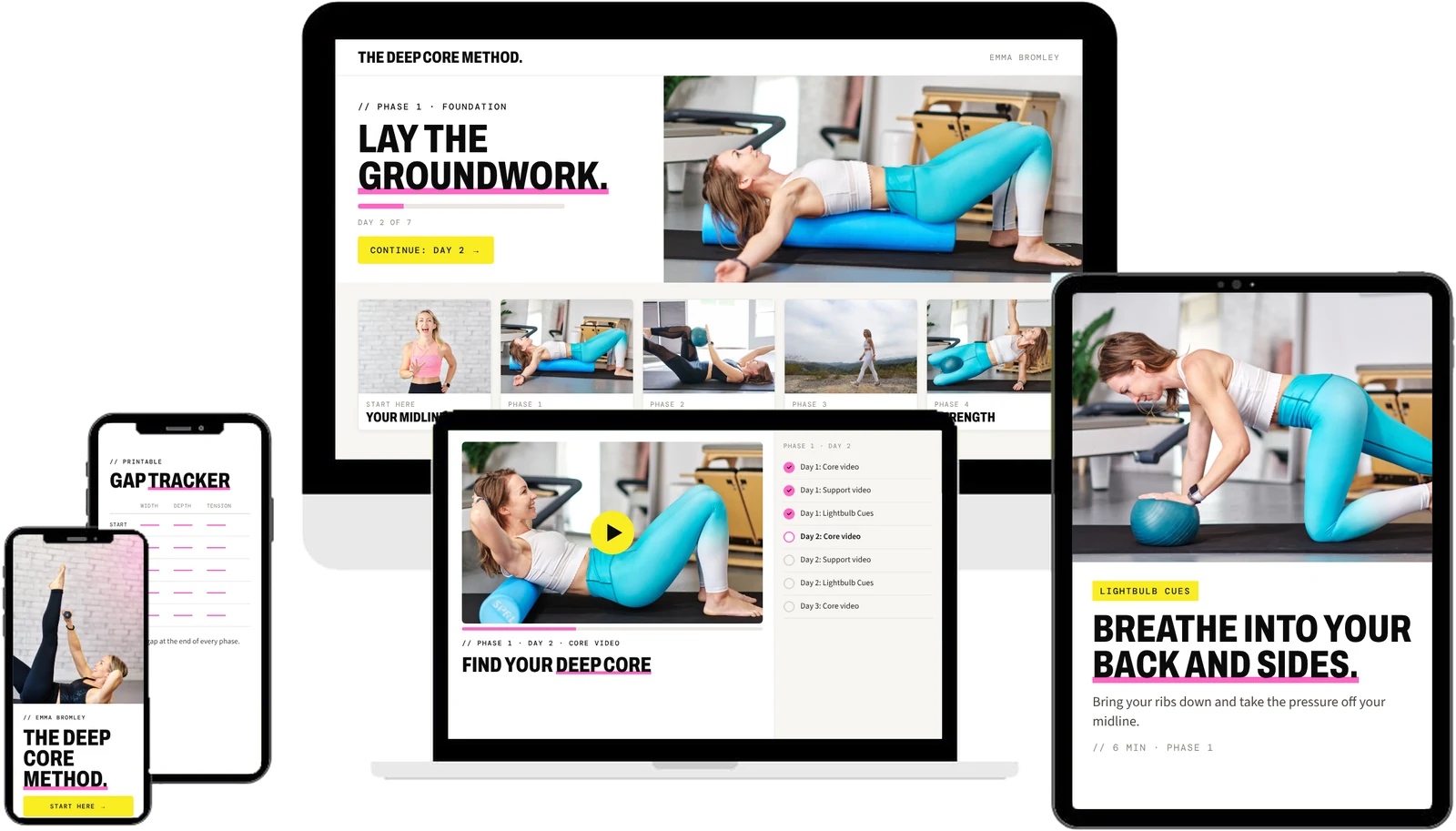
The main deep core work for the day.
Full-body strength, mobility and real-life movement.
A short teaching video where I explain the why behind what you're doing.
Most days have three short videos. Plan on 20 to 35 minutes a day, 5 to 6 days a week.
Before you do a single exercise, you'll test your own midline with me, step by step.
// You'll get
Find your deep core and take the pressure off your midline.
// In this phase
Keep that connection while your arms and legs move.
// In this phase
Put your deep core to work off the mat.
// In this phase
Add load and get back to the workouts you love.
// In this phase
// Also included
Track your gap month by month, and check off each phase when you're ready to move on.
For the most common sticking points: can't feel your deep core, upper abs taking over, doming during an exercise, and progress that's stalled.
On phone, tablet or computer.
Building gradually from a mat, towels and a resistance band (full list in the questions below).
90 videos in total: 10 Start Here videos plus 80 across the four phases.
// Read this before you join
// The Deep Core Method is for you if
// It's probably not the right fit if
// Start today
Here's everything you get
Join the waitlist and you'll be the first to know when doors open.
// Your investment is protected
The Deep Core Method is a one-time payment, with no subscription, and you can come back to it as many times as you need.
Work through the first two phases at your own pace. If it isn't right for you, email support@thebromleymethod.com within 30 days of purchase and I'll refund your investment. Simple as that.
I'm offering this because I'm that confident it's unlike anything you've tried before.
// Your questions
Everyone starts in a different place, so I won't give you a number. Each phase is seven days, and you repeat a phase until you've passed its check. Connective tissue remodels more slowly than muscle, so steady practice over months matters more than any single week.
The program is self-paced, with a short teaching video almost every day so you always know why you're doing what you're doing. If you'd love more support, you'll have the option to join my group coaching after you buy.
Every phase starts gently and only adds challenge once you can keep tension through your midline. You'll learn what a firm dome looks and feels like, when to ease back, and what to do instead. Crunches and twisting only come in once you've passed the earlier checks, and the check at the end of each phase tells you whether to move on or repeat.
The research I train from shows women can keep making progress years down the road. Some of the women I've taught started 18 years after their last birth.
Yes. Diastasis isn't only linked to pregnancy. I also see it in athletes and in women who've never had children. The program works on how your core manages pressure, whatever the starting point.
The Start Here module walks you through checking your own gap, step by step. Finger checks are a useful guide but not perfectly precise. Ultrasound with a physio is the most accurate way to measure, if you'd like a professional assessment.
Yes, in time. They're built into the later phases, once you can keep tension through your midline without a firm dome.
Yes. Holding a plank and managing pressure through your midline are different skills. Phase 1 is what makes every later exercise work for your gap.
The program trains your breath, deep core and pelvic floor together. If you have prolapse, leaking or pelvic pain, keep working with a pelvic floor physio alongside it. If your pelvic floor feels tight, you can add The Tight Pelvic Floor Fix at checkout and use it alongside the program.
This program was not designed for use during pregnancy. Please talk to your healthcare provider about exercise during pregnancy.
That's a decision to make with your surgeon. Building core strength and coordination is useful whichever path you choose, and you can bring this program to that conversation.
Equipment isn't included with the program, and you may already have most of it at home. To start: a mat, two towels, a small soft ball or yoga block, a few balloons, a long resistance band with a door anchor, and a wall. From Phase 2 you'll add a foam roller, a tennis ball, a mini band and a sturdy chair, and from Phase 3 one light and one moderate dumbbell or kettlebell.

// A note from Emma
If you've been doing the work and your gap still hasn't changed, I'd love to teach you this the way I wish someone had taught me.
Emma
P.S. I spent two years doing more core work and watching my gap get wider. What changed everything was learning how to breathe, load and progress in a way my midline could handle. Those lessons became my Lightbulb Cues, and every video in The Deep Core Method is built on them.